Listen first
Three of the pieces that come with the app, recorded straight from its sound engine.
What it does
A chord you can drag
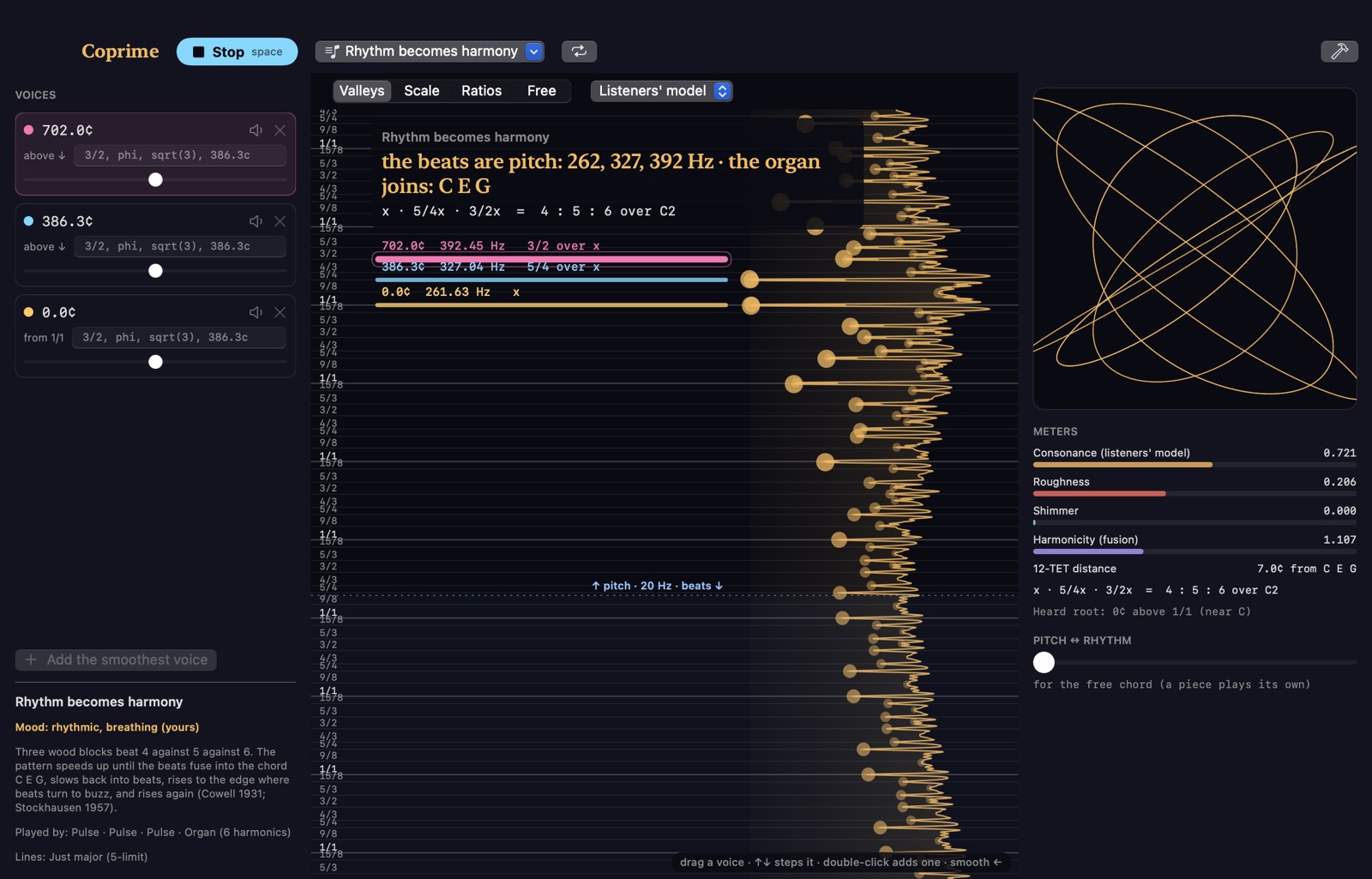
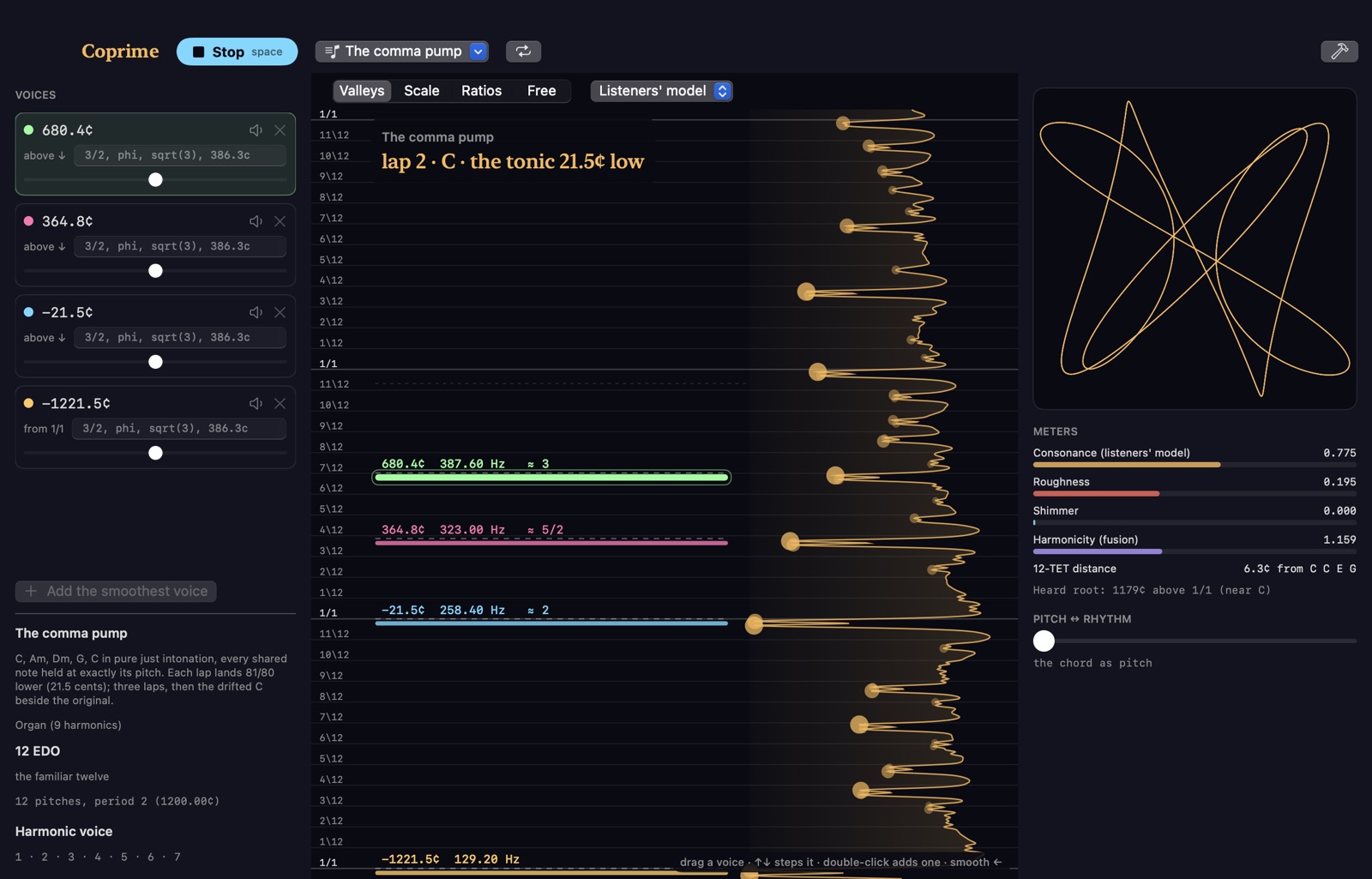
Every voice is a string on a pitch line. Drag one and it glides as you go. Beside it, a curve shows how smooth the chord would be at every height, in the timbre you chose, and the voice settles into the valleys.
The maths of every sound
Each chord is written out as it plays: x · 5/4x · 3/2x = 4 : 5 : 6,
2^(7/12) ≈ 3/2 − 2.0¢, x · φx · φ²x. Type any interval: 7/4,
phi, sqrt(3).
Any tuning
Forty-one built in, from twelve equal steps to Partch's 43, measured Javanese gamelan, Turkish makam theory, Bohlen-Pierce (no octave at all) and Wendy Carlos's alpha. Or open any Scala file.
Any timbre
Voices, reeds and organs; struck bars and drumheads; church bells with a minor or a major third; a gamelan bonang; bells built on the golden ratio. Fit a timbre to a scale and its intervals turn smooth.
Rhythm is pitch, slowed down
Slide any chord down by octaves and it becomes its own polyrhythm; speed a polyrhythm up and it becomes a chord. The harmonograph draws the same figure at every speed.
Four meters, not one
Roughness, shimmer (slow beating, which people like), fusion into one sound, and distance from the familiar twelve. Smooth is not the same as beautiful, and Coprime does not pretend it is.
The science underneath
Coprime was designed from the research, not from habit. Some of what it builds on:
- William A. Sethares: a timbre and its scale belong together (Tuning, Timbre, Spectrum, Scale; JASA 1993), after Plomp and Levelt (1965) on roughness.
- Raja Marjieh, Peter Harrison, Harin Lee, Fotini Deligiannaki and Nori Jacoby (Nature Communications, 2024): how timbre moves where consonance lives, from 235,440 listening judgements. Their model draws Coprime's curves.
- Peter Harrison and Marcus Pearce, after Andrew Milne: harmonicity, the pull towards one fundamental.
- Josh McDermott and colleagues: a preference for consonance is not universal, but a dislike of roughness nearly is.
- Psyche Loui and David Wessel: people learn a never-heard scale in under an hour.
- Erv Wilson, Heinz Bohlen, John R. Pierce and Max Mathews, Wendy Carlos, Harry Partch; Henry Cowell and Léon Theremin's Rhythmicon; Karlheinz Stockhausen.
Needs, and what it keeps
A Mac with macOS 15 or later, Apple silicon or Intel. Headphones or good speakers help: the shimmer is quiet.
Coprime collects nothing and sends nothing; it does not use the network. This page sets no cookies and loads nothing from anywhere else. Privacy, in full.
The full source code is published beside the app, built from the same commit: the sound engine in C, the mathematics and the app in Swift, the checks it must pass, and the research behind it.
Questions and ideas: coprime@cadencevideoplayer.com.