
What the app does
A viewer for what real-time video-interpolation shaders make of motion.
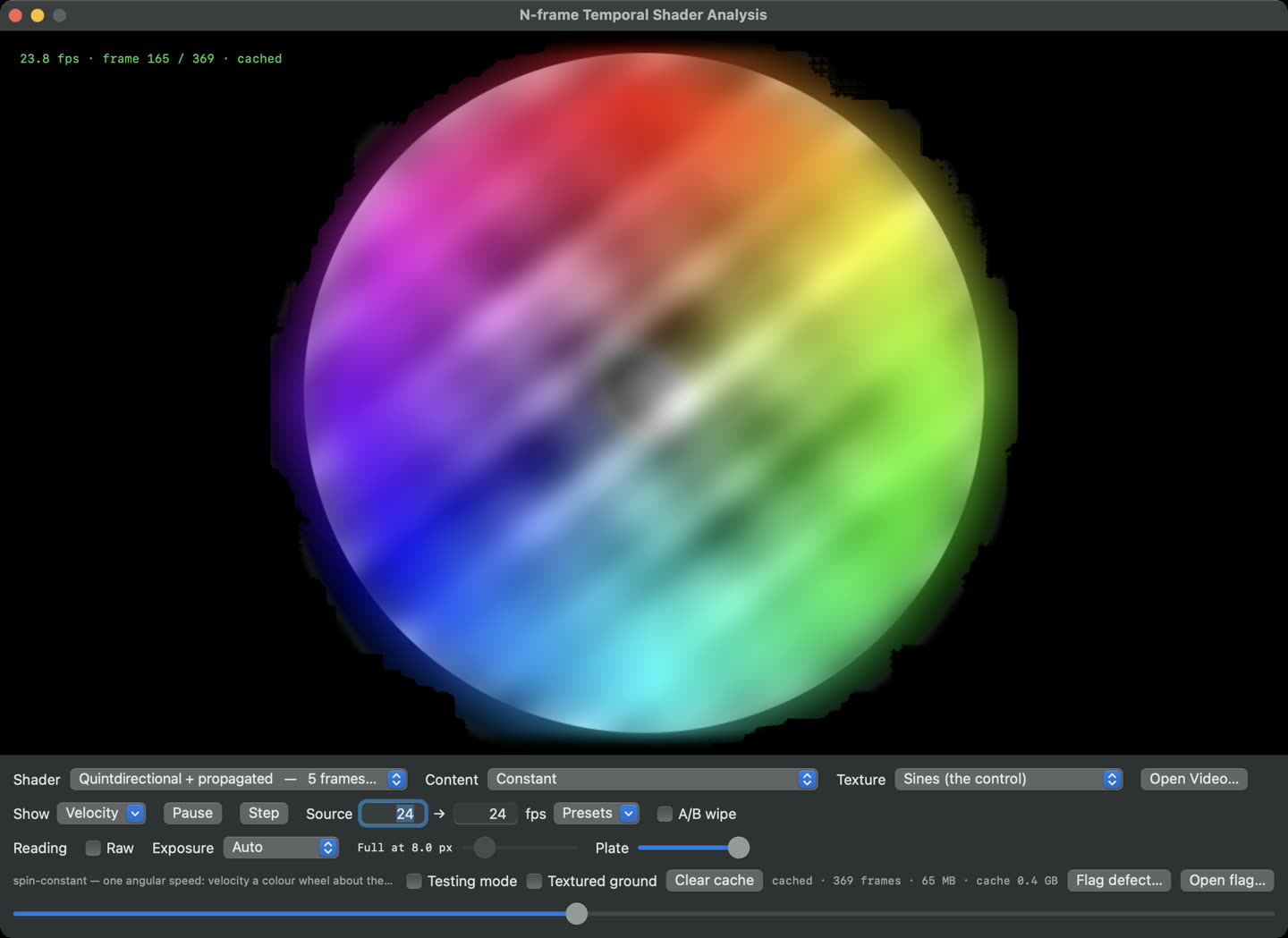
N-frame Temporal Shader Analysis runs a family of frame-interpolation shaders, from two-frame to six-frame, on the GPU of an Apple silicon Mac and lets you watch the machine's own reading of motion. Each shader estimates a velocity for every texel as it works; the app paints that estimate over the picture, hue for direction and brightness for speed, and does the same for acceleration and jerk. You can step frame by frame, wipe between shaders, change the source and target frame rates, and switch the reading between the shader's painted view and the raw field.
The content comes with exact answers. The bundled scenes are drawn from laws of motion, so the true velocity under every pixel is known: a rectangle bouncing under five speed laws, a breathing disc, spinning discs, rolling wheels, and scenes of many bodies at once (snow, fish, orbiting planets, a roundabout). Rendered manifolds add curved, self-occluding motion. And any video of your own opens with Open Video…, 4K included, and plays through the shaders live.

Requires macOS 13 or later on Apple silicon. The app has no account, no network access and no analytics; see privacy.
Support
A question, a defect, a suggestion: write to the developer.
nframedemo@cadencevideoplayer.com
It helps to say which version of the app and of macOS you are on (About in the app's menu; the Apple menu for macOS).
Reporting a defect? The app's Flag defect… button writes a small file naming the shader, the content, the frame and every setting at that moment. Paste its contents into your email and the problem can be reproduced exactly.
Privacy
The app collects nothing.
N-frame Temporal Shader Analysis makes no network connections, has no accounts, no analytics and no advertising, and sends nothing anywhere. The only files it writes are on your Mac: its own render caches, and a defect flag when you press Flag defect…, which stays in the app's folder until you choose to share it. Videos you open are read from where they are and never copied elsewhere.
Support email is read only to answer you, and nothing you send is shared with anyone.